
Haru-4B vs LFM3-Omni-2B
Compare Haru-4B and LFM3-Omni-2B.
| Dimension | Haru-4B | LFM3-Omni-2B | Source |
|---|---|---|---|
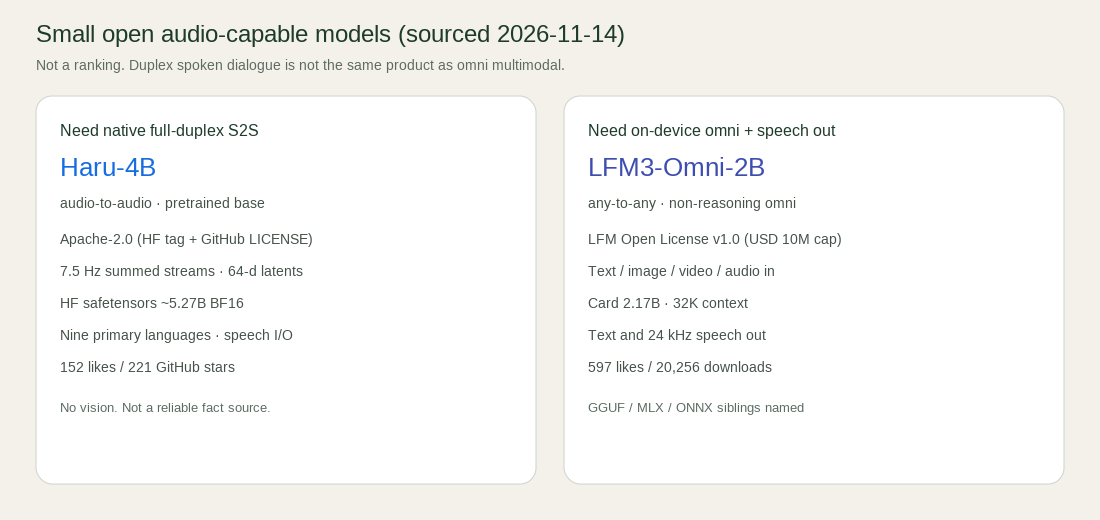
| Job | Native full-duplex speech-to-speech dialogue (pretrained base) | Omni any-to-any (text/image/video/audio in; text + 24 kHz speech out) | Official cards (2026-11-14 / 2026-10-31) |
| License (weights) | Apache-2.0 tag (cardData + README; LICENSE blob on GitHub, not on HF) | LFM Open License v1.0 (USD 10,000,000 commercial-revenue threshold) | Official cards / LICENSE files |
| Gating | No | No | Hugging Face API |
| Developer | higurashi (higurashi-ai) | Liquid AI | Official cards |
| Parameters | HF safetensors 5,270,000,897 (~5.27B BF16); UI line 5B | 2.17B card (safetensors 2,166,928,384) | Hugging Face API |
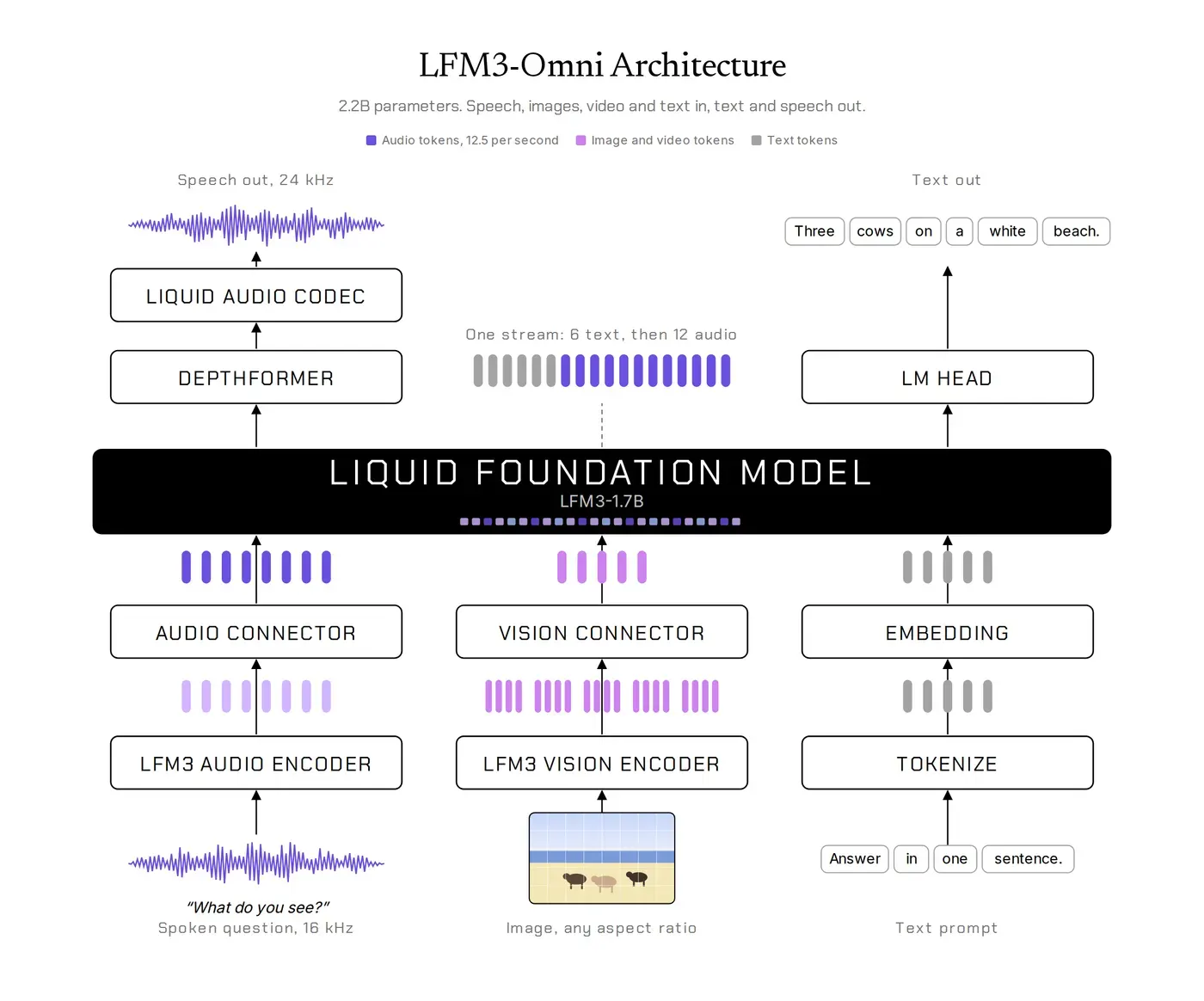
| Architecture | 7.5 Hz summed streams; Qwen3.5-4B text LM; 64-d MeanFlow MLP; VibeVoice codec | lfm3_omni; LFM3 vision + causal audio encoder; LiquidCodec | Official cards / config.json |
| Modalities | User audio in; model audio + text out (no vision on the card) | Text, images, video ± soundtrack, 16 kHz audio in; text and 24 kHz speech out | Official cards |
| Duplex | Native full-duplex at 7.5 Hz (card) | Not documented as native full-duplex on the Omni card we opened | Haru card; LFM3-Omni README |
| Hugging Face likes | 152 (2026-11-14) | 597 (2026-11-14); 227 on the 2026-10-31 Omni page snapshot | Hugging Face API |
| Quality vs ElevenLabs | Not independently tested | Not independently tested | n/a |
When to choose which
- Native full-duplex spoken dialogue on a local GPU / Mac app: Haru-4B — Pretrained base, not an instruction-tuned assistant. Latency rows stay vendor. Not a quality rank.
- One small omni checkpoint (vision + speech out, GGUF/MLX/ONNX named): LFM3-Omni-2B — LFM Open License v1.0 has a USD 10M commercial-revenue cap. Not a voice studio.
- Apache-2.0 weight tag with a GitHub LICENSE blob: Haru-4B — Omni is LFM 1.0, not Apache. Not legal advice.
- Image or video in: LFM3-Omni-2B — Haru card we opened is speech/text. No vision.
Read the entity pages: Haru-4B and LFM3-Omni-2B. Both hang off ElevenLabs alternatives as downloadable speech-capable weights, not hosted studios. Omni also hangs off closed LLM APIs and ChatGPT alternatives. Related Liquid audio (no vision): LFM3-Audio-2B. Haru-4B ≠ LFM3-Omni-2B.
Why this comparison exists
higurashi published Haru-4B on 2026-11-13 as an ungated Apache-2.0 full-duplex spoken-dialogue base. This site already identifies LFM3-Omni-2B. Searchers looking for small, local, open, audio-capable models hit both names. That is why the page exists. It is not a quality ranking. Native duplex dialogue is not the same job as omni multimodal.
Moshi is named on Haru’s GitHub README as related full-duplex context. There is no Moshi or Freeze-Omni page on this site.
Sourced snapshot (Haru 2026-11-14 / Omni likes refreshed 2026-11-14, Omni card body 2026-10-31)
| Field | Haru-4B | LFM3-Omni-2B |
|---|---|---|
| Host | huggingface.co/higurashi-ai/Haru-4B (not gated) | huggingface.co/LiquidAI/LFM3-Omni-2B (not gated) |
| HF likes / downloads | 152 / 165 (2026-11-14) | 597 / 20,256 (2026-11-14) |
| License | Apache-2.0 tag; GitHub LICENSE blob | LFM Open License v1.0 |
| Size | 5,270,000,897 BF16 (~5.27B) | 2.17B card (2,166,928,384) |
| Job | Native full-duplex S2S base | Omni any-to-any + speech out |
| Vision / video | Not on the card | Images + video at 2 fps |
| Context | LM max_position_embeddings 262144 |
32K tokens (input + output) |
| Official local path | PyTorch demo; MLX macOS app; vLLM-Omni plugin | BF16 / GGUF / MLX-4bit / ONNX named |
| Quality vs ElevenLabs | Not independently tested | Not independently tested |
Omni’s on-site identification page still quotes the 2026-10-31 snapshot (227 likes / 3,080 downloads). This vs table uses the 2026-11-14 API refresh for likes/downloads only. We do not rewrite the Omni page’s dated verification block here.
Haru’s card does not print a public quality table against Omni. Omni’s card prints Liquid-measured ASR / TTS / VoiceBench / MMAR rows that stay self-reported on LFM3-Omni-2B. We do not copy those rows onto Haru.
License
Haru: Hugging Face cardData.license apache-2.0; README says Apache License 2.0; HF LICENSE path 404 on 2026-11-14; GitHub LICENSE is Apache License 2.0.
Omni: LICENSE is LFM Open License v1.0. Commercial Use is conditioned on You/Legal Entity not exceeding USD 10,000,000 annual revenue. Above that threshold, Commercial Use is not licensed under that agreement. Qualified non-profits for non-commercial/research use are exempt from the threshold.
Do not flatten Apache-2.0 with LFM 1.0. Not legal advice.
How to choose
- Need native full-duplex spoken dialogue (7.5 Hz, character card + reference voice): Haru-4B.
- Need omni + speech out (vision/video in): LFM3-Omni-2B.
- Need Liquid audio only (no vision): LFM3-Audio-2B. Sibling: LFM3-1.7B vs LFM3-Omni-2B.
- Need turn-based TTS: Qwen3-TTS, Audio8-TTS-Realistic-0.6B — Audio8 vs Qwen3-TTS — or ZONOS3-Mini.
- Need file ASR / notes, not a talking model: Granite Speech 5.0, whisper.cpp on Descript alternatives, Otter.ai alternatives.
- Need simultaneous speech MT, not duplex chat: Hy-SimulMT, Hibiki-Zero.
See also Video & Audio and Models. Catalog: home. Editorial: About. Corrections: contact.
FAQ
Which one is better for voice chat?
We have no sourced bake-off. Haru is built as native full-duplex speech-to-speech. Omni is an any-to-any omni model that can also emit speech. Those are different jobs. We do not invent a winner.
Can I run both locally?
Both publish ungated weight hosts. Haru README: about 12 GB on NVIDIA. Omni card: designed for on-device use; BF16 usedStorage ~4.19 GiB, plus GGUF / MLX-4bit / ONNX siblings. Peak VRAM is not independently measured for either.
Which license is better for commercial use?
Haru’s HF tag and GitHub LICENSE are Apache-2.0; there was no LICENSE file on the HF weight host on 2026-11-14. Omni is LFM Open License v1.0 with a USD 10,000,000 annual-revenue commercial-use threshold. Not legal advice; read the files.
Why this pairing instead of Qwen3-TTS?
Searchers looking for small local open audio models hit both a new duplex S2S base and the on-site Omni card. Qwen3-TTS, Audio8, and ZONOS3-Mini remain turn-based TTS. See those pages; they are not this vs pair.
Sources & verification
- https://huggingface.co/higurashi-ai/Haru-4B
- https://huggingface.co/higurashi-ai/Haru-4B/raw/main/README.md
- https://www.higurashi.ai/haru4b/
- https://blog.higurashi.ai/melte/haru4b/
- https://github.com/higurashi-ai/Haru
- https://github.com/higurashi-ai/Haru/blob/main/LICENSE
- https://huggingface.co/LiquidAI/LFM3-Omni-2B
- https://huggingface.co/LiquidAI/LFM3-Omni-2B/raw/main/LICENSE
- https://www.liquid.ai/blog/lfm3
License notes are not legal advice. Read the original LICENSE. Trademark & disclaimer.