
Apache-2.0audioRuns locally5.27B (HF safetensors BF16)
Haru-4B: Specs, License & How to Run
higurashi Apache-2.0 full-duplex spoken-dialogue base. Native 7.5 Hz. Not an assistant.
- License
- Apache-2.0
- Parameters
- 5.27B (HF safetensors BF16)
- HF likes
- 152 (2026-11-14)
- First seen
- 2026-11-12
TL;DR. Haru-4B is a audio model from higurashi (higurashi-ai). Parameters: 5.27B (HF safetensors BF16).License: Apache-2.0. It is listed under ElevenLabs.
| Developer | higurashi (higurashi-ai) |
|---|---|
| Type | audio |
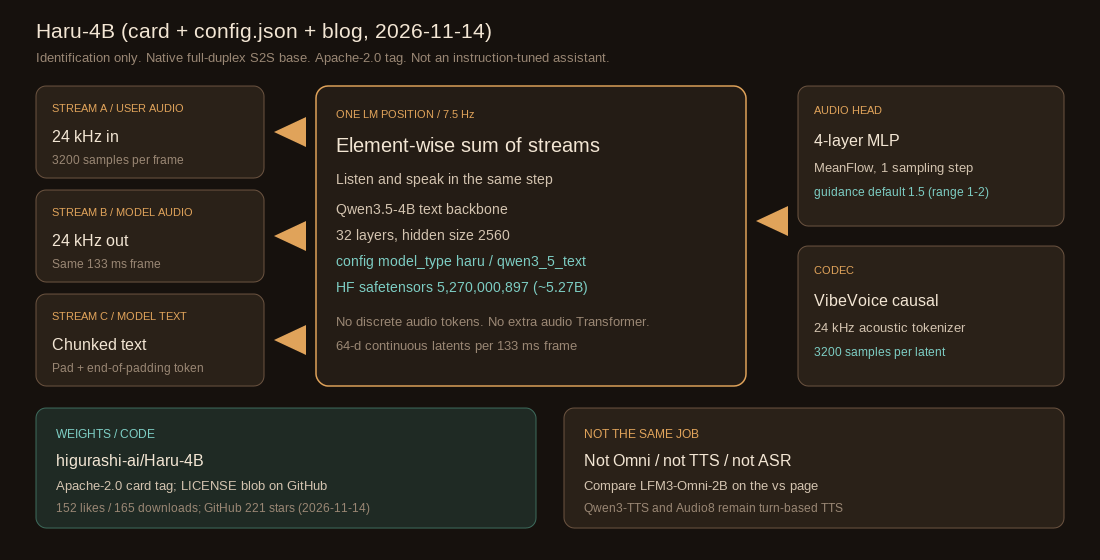
| Architecture | Native full-duplex spoken-dialogue model. Card: user audio, model audio, and model text are summed into a single language-model position at 7.5 Hz (133 ms/frame). Qwen3.5-4B text backbone (32 layers, hidden 2560). Continuous 64-d audio latents; 4-layer MLP MeanFlow head with one sampling step; causal VibeVoice acoustic tokenizer at 24 kHz, 3200 samples per latent. No separate audio transformer; no discrete audio tokens. config.json: model_type haru, architectures HaruForConditionalGeneration, lm.model_type qwen3_5_text. Distinct from LFM3-Omni-2B (omni) and from Qwen3-TTS / Audio8 (turn-based TTS). |
| Parameters | 5.27B (HF safetensors BF16) |
| Modalities | audio, speech, text |
| Languages | English, Spanish, Portuguese, German, French, Chinese, Japanese, Russian, Korean |
| Context | LM max_position_embeddings 262144 (config.json) |
| License | Apache-2.0 — Hugging Face cardData.license is apache-2.0. README: “The weights are released under the Apache License 2.0.” There is no LICENSE blob in the HF siblings list (raw LICENSE 404 on 2026-11-14). Companion GitHub higurashi-ai/Haru LICENSE is Apache License 2.0; GitHub license API Apache-2.0. README: code and Haru-4B weights are Apache-2.0. PyPI haru-speech is Apache-2.0. Not legal advice. |
| Hardware | about 12 GB (NVIDIA, README) — Card/README: NVIDIA GPU about 12 GB. Blog (2026-11-13): native Swift app on a MacBook with Apple M1 Max, int8, about 65 ms end-to-end excluding audio framing; framing adds up to 133 ms. Same blog: NVIDIA B300 encode+decode+one LM step about 15 ms. Those latency rows stay vendor. HF usedStorage is 10,560,102,835 bytes (~9.84 GiB). forkalt has not loaded the weights. (not independently tested) |
| Hugging Face likes | 152 (as of 2026-11-14) |
| Model card | https://huggingface.co/higurashi-ai/Haru-4B |
| First seen | 2026-11-12 |
Haru-4B is higurashi’s native full-duplex continuous spoken-dialogue foundation model: it listens and speaks at the same time. Official hosts we opened on 2026-11-14: the ungated card higurashi-ai/Haru-4B (created 2026-11-12T11:05:59Z; last modified 2026-11-13T01:22:38Z; 152 likes / 165 downloads), README, config.json, the product page higurashi.ai/haru4b, the tech blog Haru-4B (dated 2026.11.13), inference code github.com/higurashi-ai/Haru (221 stars / 11 forks; Apache-2.0 LICENSE; created 2026-11-12T11:15:42Z; last push 2026-11-13T06:21:17Z), and PyPI haru-speech 0.1.1 (Apache-2.0; uploaded 2026-11-13). API gated was false. Hugging Face pipeline_tag is audio-to-audio. cardData.license is apache-2.0. Live sitemap-0.xml had no /models/haru-4b/ URL when we checked.
This identification page hangs off open ElevenLabs alternatives for downloadable speech. That mapping is editorial. Haru is not a hosted voice studio and not turn-based TTS. We have no sourced quality comparison against ElevenLabs.
It is not LFM3-Omni-2B (Liquid 2.17B omni: text/image/video/audio in, text+speech out). Head-to-head identification: Haru-4B vs LFM3-Omni-2B. It is also not LFM3-Audio-2B (audio any-to-any, no vision), not Qwen3-TTS, not Audio8-TTS-Realistic-0.6B, and not ZONOS3-Mini (those three are TTS). File ASR stays on Granite Speech 5.0 and whisper.cpp. Streaming speech MT stays on Hy-SimulMT.
The card, GitHub README, official page, and blog all say this is a pretrained base model, released for research. Copied limitation: it holds a natural conversation, but it is not a reliable source of facts and does not follow instructions the way an assistant does. Latency, training-hour, and GPU-memory lines below stay vendor.
What we verified (2026-11-14)
| Field | Value | Source |
|---|---|---|
| Host | huggingface.co/higurashi-ai/Haru-4B (not gated) | HF API |
| Created / last modified | 2026-11-12T11:05:59Z / 2026-11-13T01:22:38Z | same |
| Likes / downloads | 152 / 165 | same |
| License tag | apache-2.0 (no LICENSE file in HF siblings) | HF cardData + tree |
| Code LICENSE | Apache License 2.0 | GitHub LICENSE + license API |
| Pipeline tag | audio-to-audio | HF API |
| Architecture class | haru / HaruForConditionalGeneration |
HF config |
| Params (safetensors) | 5,270,000,897 (~5.27B BF16) | HF API |
| HF UI size line | 5B params | HF model page |
| usedStorage | 10,560,102,835 bytes (~9.84 GiB) | HF API |
| LM backbone (card + config) | Qwen3.5-4B text; 32 layers; hidden 2560 | README + config.json |
| Frame rate | 7.5 Hz (133 ms / 3200 samples at 24 kHz) | same |
| Audio latent | 64-d continuous; 4-layer MLP; MeanFlow; 1 step | same |
| Codec | causal VibeVoice acoustic tokenizer | same |
| Primary languages (card) | EN, ES, PT, DE, FR, ZH, JA, RU, KO | HF cardData.language |
| GitHub stars / forks | 221 / 11 | GitHub API |
| PyPI | haru-speech 0.1.1; Apache-2.0 | PyPI |
Hugging Face’s UI can show a rounded 5B size line. We keep the API 5,270,000,897 count and the card’s Qwen3.5-4B backbone quote and do not invent a module-by-module split. Qwen/Qwen3.5-4B is a separate vision-capable card (safetensors 4,659,865,088); Haru’s lm.model_type is qwen3_5_text. There is no dedicated Qwen3.5-4B page on this site.
runsLocally: true means the Apache-2.0 checkpoint can be downloaded. forkalt has not loaded it.
Architecture (from the card, config, and blog — not counted here)
Copied from the Hugging Face README, config.json, and the 2026-11-13 blog:
- Job: end-to-end full-duplex speech-to-speech. Official page: listens and speaks simultaneously, including backchanneling, interruptions, and overlapping speech.
- Streams: user audio, model audio, and model text are summed into a single language-model position, so listening and speaking do not wait for each other. Blog: this is not token-by-token interleaving; context length is one third versus interleaved streams.
- Rate: 7.5 Hz (one ~133 ms frame in, one frame of model audio + text out).
- Audio representation: 64-dimensional continuous latents. No discrete audio tokens. No separate audio transformer.
- Head: 4-layer MLP; MeanFlow; 1 sampling step;
guidance_scaledefault 1.5 (range 1 to 2). - Codec: causal VibeVoice acoustic tokenizer; 24 kHz; 3200 samples per latent.
- Text: chunk-level alignment with padding positions and an end-of-padding token for speech initiation (
eop_token_id248071 in config). - Character / voice: a text character card sets persona; a short reference clip sets the voice (bring your own; one speaker, 3 seconds to 3 minutes, clean speech; only use voices you have the right to use). Haru ships without voice clips.
The GitHub README credits Moshi as a pioneering full-duplex speech model and notes the web client is derived from the Moshi web client. That is related context, not a forkalt Moshi page. Same-site streaming S2ST (translation, not duplex chat) is Hibiki-Zero.
Training claims (vendor / blog)
Copied from the tech blog only. Self-reported.
- About 40 million hours of real speech; data spanning 160+ languages; primary focus on nine: English, Spanish, Portuguese, German, French, Chinese, Japanese, Russian, Korean.
- Intentionally no LLM-generated dialogues and no TTS-synthesized speech in the training mixture.
- Stage 2: over 13 million hours of separated full-duplex dialogue; samples up to 60 minutes.
- Pretraining: 256 NVIDIA B200 GPUs, about 8 days, Megatron-LM.
- Speech restoration names Sidon; mixed-conversation separation names FastDialogueSidon. Those are upstream tools, not extra forkalt URLs.
We did not re-count hours or GPUs.
How to run (from official docs, not tested)
Copied names only. forkalt has not loaded a checkpoint.
PyTorch / NVIDIA (README: about 12 GB). From the card:
git clone https://github.com/higurashi-ai/Haru && cd Haru
pip install -e ./haru
python -m haru.server --hf-repo higurashi-ai/Haru-4B
Open http://localhost:8998, pick a character, give the model a voice, and talk. README: wired headphones and a wired microphone for low latency; Bluetooth adds 100 ms or more. PyPI extra: pip install haru-speech then haru-server --hf-repo higurashi-ai/Haru-4B. Optional Triton codec backend is documented as about 0.7 ms instead of 6 ms per encode/decode frame — vendor.
Apple silicon: haru_mlx plus a native Swift app (./build_app.sh → Haru.app). Blog latency table for that path is int8 and excludes audio framing.
GPU serving: haru_vllm plugin for vLLM-Omni. Demo can point at it with --backend vllm. Related engine page on this site: vLLM.
Python shape copied from the card:
from haru import DuplexSession, HaruModel
from haru.audio import load_audio, prepare_reference

model = HaruModel.from_pretrained("higurashi-ai/Haru-4B")
voice = prepare_reference(load_audio("voice.wav"))
session = DuplexSession(model, system_prompt=card, reference=voice)

frame = session.start()
while not frame.done:
    frame = session.step(user_audio)  # 3200 samples at 24 kHz in, 3200 out
Hosted Hugging Face Space hugging-apps/haru-4b is a demo, not the weight grant.
Vendor latency (self-reported)
The blog prints an int8 MacBook M1 Max breakdown whose p50 total is 65.2 ± 1.5 ms, excluding framing. Copied stages: input 5.3 ms, one model step 34.2 ms, socket/handoff 4.1 ms, output wait 13.3 ms, output 8.1 ms. Framing at 7.5 Hz adds up to 133 ms of algorithmic latency. NVIDIA B300: encode+decode+one LM step about 15 ms. Those rows stay vendor. They are not an ElevenLabs, Omni, or Moshi bake-off.
License
Weights: Hugging Face cardData.license is apache-2.0. README: “The weights are released under the Apache License 2.0.” There was no LICENSE file in the HF siblings list on 2026-11-14 (raw URL 404).
Code: github.com/higurashi-ai/Haru/LICENSE is Apache License 2.0. GitHub license API: Apache-2.0. README: “The code and the Haru-4B weights are released under the Apache License 2.0.” PyPI haru-speech is Apache-2.0.
The card still requires using only voices you have the right to use. Not legal advice.
What we did not invent
- Peak VRAM, tokens/s, and the Mac 65 ms / B300 15 ms lines stay unmeasured / vendor.
- 40 million hours, 160+ languages, and 60-minute duplex training stay blog / self-reported.
- We do not rank Haru-4B against LFM3-Omni-2B, Qwen3-TTS, ElevenLabs, or Moshi.
- We do not publish Moshi or Freeze-Omni identification pages.
Related: Haru-4B vs LFM3-Omni-2B — LFM3-Omni-2B — LFM3-Audio-2B — Qwen3-TTS — Audio8-TTS-Realistic-0.6B — ZONOS3-Mini — Granite Speech 5.0 — Hy-SimulMT — Hibiki-Zero — whisper.cpp — vLLM — ElevenLabs alternatives — Otter.ai alternatives — Descript alternatives — Video & Audio. Catalog: models. Corrections: contact.
Benchmarks
Quoted from the cited source. forkalt has not independently reproduced these numbers.
| Name | Score | Source |
|---|---|---|
| End-to-end latency on MacBook M1 Max, int8, excluding framing (blog) | about 65 ms (p50 65.2 ± 1.5 ms) (self-reported) | https://blog.higurashi.ai/melte/haru4b/ |
| NVIDIA B300 encode + decode + one LM step (blog) | about 15 ms (self-reported) | https://blog.higurashi.ai/melte/haru4b/ |
| NVIDIA GPU memory (README) | about 12 GB (self-reported) | https://huggingface.co/higurashi-ai/Haru-4B |
Deploy options
Comparisons
FAQ
Are Haru-4B weights public?
Yes. huggingface.co/higurashi-ai/Haru-4B is ungated (created 2026-11-12T11:05:59Z; last modified 2026-11-13T01:22:38.000Z; 152 likes / 165 downloads in the 2026-11-14 API check; pipeline_tag audio-to-audio; card license apache-2.0). API gated was false. Inference code: github.com/higurashi-ai/Haru (221 stars / 11 forks; Apache-2.0 LICENSE). PyPI package haru-speech 0.1.1 (Apache-2.0).
Is it an instruction-tuned assistant?
No. The card, GitHub README, official page, and tech blog all call it a pretrained base model released for research. It can hold a natural conversation, but it is not a reliable source of facts and does not follow instructions the way an assistant does. That wording is copied from the card.
Can I use the weights commercially?
The HF card tag and README say the weights are Apache License 2.0. There is no LICENSE file in the HF tree we opened. The GitHub repo LICENSE is Apache License 2.0 for code and, per the README, the Haru-4B weights. Read both. Not legal advice.
Does it replace ElevenLabs, LFM3-Omni-2B, or Qwen3-TTS?
We do not claim that. Haru is native full-duplex speech-to-speech dialogue, not a hosted voice studio, not an omni vision model, and not turn-based TTS. See Haru-4B vs LFM3-Omni-2B. No sourced quality bake-off.
Sources & verification
- https://huggingface.co/higurashi-ai/Haru-4B
- https://huggingface.co/higurashi-ai/Haru-4B/raw/main/README.md
- https://huggingface.co/higurashi-ai/Haru-4B/raw/main/config.json
- https://www.higurashi.ai/haru4b/
- https://blog.higurashi.ai/melte/haru4b/
- https://github.com/higurashi-ai/Haru
- https://github.com/higurashi-ai/Haru/blob/main/LICENSE
- https://pypi.org/project/haru-speech/
- https://www.apache.org/licenses/LICENSE-2.0
License notes are not legal advice. Read the original LICENSE. Trademark & disclaimer.